Roadside situations rarely unfold in a predictable way. A vehicle might slow down without warning, or a simple component issue can interrupt an otherwise ordinary trip. In those moments, drivers usually shift attention from driving to immediate problem handling, then to waiting and safety awareness.
A Roadside Survival Kit exists within this gap. It is not a fixed solution for every scenario, but rather a collection of tools that supports basic actions when conditions become uncertain. What matters more than the items themselves is how they align with real roadside behavior: staying visible, staying safe, and maintaining a workable environment until normal travel resumes.
Different drivers also interpret preparedness differently. Some focus on mechanical needs, while others prioritize visibility or personal comfort. Because of this, the structure of a kit tends to vary more than it first appears.
A practical roadside kit usually reflects a mix of small mechanical aids, signaling tools, and basic personal support items. Instead of trying to cover every possible situation, it tends to focus on what is likely to be needed during short interruptions.
In real use, items are often grouped by function rather than category labels:
A Roadside Survival Kit is often judged less by quantity and more by how quickly a driver can identify and reach what is needed.
| Category | Practical role during roadside situations |
|---|---|
| Mechanical support | Helps address small vehicle interruptions |
| Visibility support | Makes the stopped vehicle easier to notice |
| Personal safety | Reduces exposure while waiting nearby |
| Utility tools | Supports small adjustments or handling tasks |
This kind of structure avoids overloading storage while still covering common roadside patterns.
The environment plays a strong role in how roadside situations unfold. On highways, the main concern is usually surrounding traffic movement, which creates a need for early visibility and clear signaling. In contrast, rural or low-traffic roads often shift attention toward waiting conditions and limited external help.
In both cases, a Roadside Survival Kit functions as a transition tool between the moment of interruption and the arrival of assistance. It helps drivers stabilize the situation in small steps rather than reacting all at once.
Typical responses supported by such a kit include:
The usefulness is not tied to complexity but to how naturally the tools fit into these short, practical actions.
Roadside conditions can shift how reliable or usable certain tools feel in practice. Temperature changes, moisture, and surface type often influence both handling and storage behavior inside a vehicle.
Cold conditions may make certain materials less flexible, which affects how tools are held or deployed. Warmer environments can influence how items are stored over time, especially when left in enclosed spaces. Wet or uneven surfaces also change how stable setup actions feel near the vehicle.
Instead of treating the kit as static, it is more realistic to view it through situational interaction:
A Roadside Survival Kit therefore behaves less like a fixed object and more like a system that reacts differently depending on surroundings.
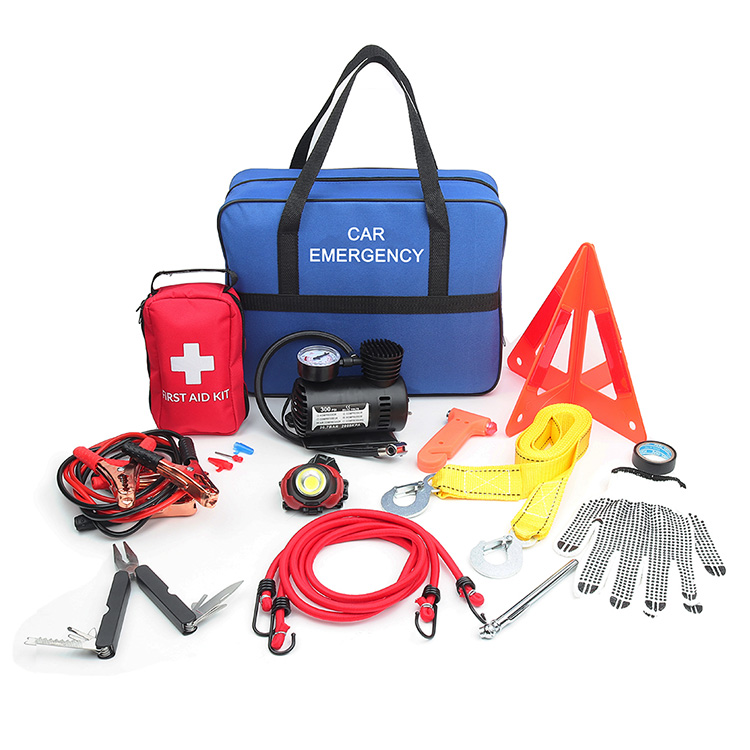
Vehicle size and layout directly influence how a kit is stored and accessed. A compact car usually requires tighter organization, while larger vehicles allow more flexible arrangement and separation of tools.
The key point is not simply storage capacity but how quickly items can be reached when needed.
| Vehicle type | Practical configuration focus |
|---|---|
| Sedan | Compact layout with essential items close together |
| SUV | Balanced storage with clearer internal separation |
| Truck | Layered arrangement with broader tool distribution |
In practice, a Roadside Survival Kit should not interfere with daily vehicle use. If access feels slow or unclear during normal conditions, it tends to become even more difficult during stressful roadside moments.
Small design decisions such as compartment layout or item grouping often have more impact than the number of included tools.
Nighttime roadside situations tend to change the way drivers perceive distance, risk, and movement. Reduced visibility makes even simple actions feel slower, and the environment around the vehicle becomes harder to judge. In that setting, tool selection is less about variety and more about clarity and immediate usefulness.
A few tool groups appear more frequently in practice because they support orientation and awareness rather than complex repair tasks.
A Roadside Survival Kit in nighttime use is often judged by how quickly a driver can make themselves visible and stable within the roadside environment, not by how many tools are available.
Under stress, decision-making becomes less structured. Drivers may remember that tools exist but lose clarity on where they are placed. Because of this, organization is not only a storage concern but also a behavioral one.
A practical arrangement usually follows the logic of frequency and urgency. Items used first should require the least searching, while rarely used components can remain in secondary positions.
A simple structure often works better than layered complexity:
| Placement zone | Purpose in real use |
|---|---|
| Immediate reach zone | Items needed within seconds of stopping |
| Mid storage zone | Tools used after initial stabilization |
| Deep storage zone | Rarely used backup components |
A Roadside Survival Kit designed this way reduces hesitation during roadside moments. The goal is not to memorize placement, but to make retrieval almost automatic even under pressure.
Response time during roadside events is rarely determined by a single tool. More often, it is influenced by how the kit is physically arranged and how naturally a driver can interpret it without instructions.
Small structural decisions tend to have a noticeable impact in real situations:
When these elements are aligned, a Roadside Survival Kit becomes easier to navigate even without prior practice. When they are not, even simple tasks may take longer than expected during roadside stress.
The design challenge is less about adding features and more about reducing hesitation.
Not all drivers approach roadside situations with mechanical familiarity. In many cases, users rely on visual cues and simple step-by-step thinking rather than technical understanding. This makes usability a key factor in how effective a kit feels during real use.
Instead of technical depth, clarity and structure often matter more.
In practice, a Roadside Survival Kit becomes easier to use when it aligns with intuitive behavior rather than mechanical logic. The less interpretation required, the smoother the response tends to be in roadside conditions.
No. 52, Hulian West Street, Jiangbei Street, Dongyang City, Jinhua City, Zhejiang Province, China
Quick Links
Product Center
Contact Us
 PRIVACY

 English
 Deutsch
 Français
 русский
 Español