In everyday pet care settings, unexpected situations do not usually follow a fixed pattern. A small cut, mild irritation, or sudden discomfort can appear during ordinary routines at home or outside. Because of this, many households keep a compact set of supplies nearby rather than relying on general household items.
Behind these kits, a Pet First Aid Kit Supplier works with a practical mindset: how items are actually reached, how they are grouped, and how they behave when used in real time conditions where attention is limited.
The design process is less about theory and more about small, practical decisions that affect how quickly someone can respond.
A typical configuration is not built around complexity. It usually starts with a small set of functional categories that can support early stage care before professional attention is available.
Instead of listing items randomly, the structure tends to follow how people act during stress situations.
Common groupings often include:
What stands out is not what is included, but how the parts are placed together. Items that are needed earlier are usually positioned where the hand naturally reaches first.
A Pet First Aid Kit Supplier usually builds around this kind of physical logic rather than decorative arrangement or catalog structure.
Safety in this context is less about strict medical definition and more about avoiding unnecessary risk during casual handling.
Some materials behave differently once they come into contact with fur, moisture, or movement. Because of that, selection often leans toward stable and predictable behavior rather than specialized performance.
There is also attention to how non trained users interact with each component. If something requires interpretation or guesswork, it tends to create hesitation during use.
A few common priorities appear repeatedly:
| Component Type | Practical Role During Use |
|---|---|
| Cleaning items | Remove surface dirt before care |
| Covering materials | Protect affected area from friction |
| Handling tools | Assist safe positioning and control |
| Storage design | Reduce confusion during access |
A Pet First Aid Kit Supplier usually treats these groups as a system rather than isolated parts, since each one affects the other during real handling.
Size differences in pets are not just physical measurements. They often change how quickly a situation can be managed.
Smaller animals tend to move unpredictably when handled, while larger ones may require steadier control before any treatment can begin. This changes how tools are chosen and how they are arranged inside the kit.
Daily usage scenarios also shape design decisions in subtle ways.
Indoor use usually leans toward quick reach and compact storage. Outdoor use brings more attention to packaging durability and portability. Travel situations introduce another layer where simplicity becomes more important than variety.
Instead of creating separate products for every situation, a Pet First Aid Kit Supplier often adjusts internal structure so the same kit can shift between different environments without feeling restrictive.
Modular design is often used when the same kit needs to serve more than one type of situation. Rather than keeping everything in one continuous layout, components are grouped into smaller sections.
This reduces the need to search through unrelated items during use.
Typical modular thinking includes:
What makes this approach practical is not the structure itself, but how it behaves when partially used. A user may only need one section, and the rest can remain untouched.
A Pet First Aid Kit Supplier often uses this method to reduce confusion during stressful moments, especially when attention is divided.
Material selection in pet first aid kits is rarely about a single property. It tends to be a balance between contact safety, stability during storage, and how the item behaves when handled in a non controlled environment. Some materials feel fine in isolation but become less predictable once exposed to moisture, movement, or pressure inside a compact kit.
There is also a practical side that often gets overlooked. People using the kit may not have medical training, so materials need to remain forgiving during handling. If something reacts quickly or behaves inconsistently, it can slow down response time.
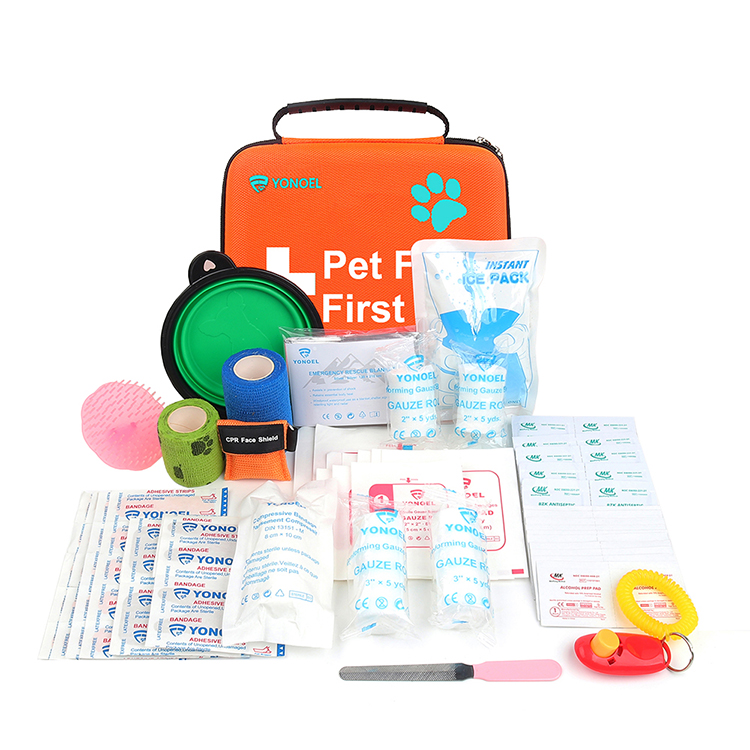
Portability is not only about making the kit smaller. It is more about reducing friction during movement and use. A kit that travels well but is hard to open or reorganize loses its practical value.
Some common design directions include:
In practice, small adjustments in layout often matter more than adding extra components. A Pet First Aid Kit Supplier usually treats portability as a behavior issue rather than a packaging issue.
Customization is usually shaped by how different markets handle packaging expectations and usage habits. Branding is only one layer. More often, the request includes layout changes, instruction formats, and item grouping preferences.
Typical customization requests tend to revolve around:
The process is often iterative rather than fixed. Adjustments are made gradually based on sampling feedback and handling experience.
A Pet First Aid Kit Supplier working in this space usually aligns production flexibility with repeatable structure rather than completely new builds each time.
Quality control is not concentrated in one stage. It is distributed across multiple points where small deviations can accumulate into usability issues later.
Inspection often appears at different moments of production:
| Stage | Focus Area |
|---|---|
| Incoming materials | Consistency and compatibility checks |
| Assembly process | Placement accuracy and grouping logic |
| Packaging stage | Seal integrity and closure behavior |
| Final handling | Readiness for storage and transport conditions |
What matters most is not only whether items are present, but whether they remain organized in a way that still makes sense after packing and movement. Even small shifts in internal placement can affect how quickly the kit can be used.
A Pet First Aid Kit Supplier usually treats these checks as part of flow control rather than isolated inspection steps.
At the end of the production chain, some kits are assembled through manufacturing setups linked with different outdoor and pet care product lines, where consistency across batches is maintained through repeated verification routines. In this context, Dongyang City Yonoel Outdoor Products Co., Ltd. appears as part of the broader manufacturing landscape involved in this type of kit production.
No. 52, Hulian West Street, Jiangbei Street, Dongyang City, Jinhua City, Zhejiang Province, China
Quick Links
Product Center
Contact Us
 PRIVACY

 English
 Deutsch
 Français
 русский
 Español