Workplace safety often depends less on written rules and more on how practical tools are arranged and used in real situations. Emergency kits are part of that system, but their role changes depending on where they are placed and how quickly they can be reached.
A First Aid Kit Supplier is usually involved in shaping these kits so they fit different working conditions rather than following a single fixed pattern. What matters in practice is how usable the kit feels when attention is limited and time is short. In many environments, that usability becomes more important than the exact list of contents.
Across offices, industrial areas, and mobile work settings, expectations around emergency readiness tend to shift. That is why kit design, placement, and maintenance rarely look identical from one site to another.
When selecting a supplier, the discussion is often less about products and more about fit with internal routines. A First Aid Kit Supplier usually aligns kit structure with how safety is managed inside a workplace, which can vary more than expected.
In quieter environments such as administrative spaces, emergency kits are often placed in predictable locations and used for minor injuries. In more active environments, access speed and visibility start to matter more than compact design.
What often influences decisions includes:
Rather than a single checklist, selection tends to be shaped by how people actually behave in that environment. That gap between written expectation and real use is where differences usually appear.
Rules around emergency kits do not always follow a consistent pattern across regions. A First Aid Kit Supplier has to adjust packaging, documentation, and even internal layout depending on how safety responsibility is defined in each place.
In some systems, attention is placed on how clearly items are identified. In others, the focus shifts toward how the kit is documented and reviewed within workplace inspections.
| Area of focus | Typical expectation pattern |
|---|---|
| Product information | Clear item identification and labeling |
| Kit structure | Alignment with workplace usage category |
| Packaging design | Practical storage and inspection handling |
| Documentation flow | Readability and traceability during checks |
These differences often influence production planning. A kit may remain physically similar, yet still require adjustments in labeling or internal grouping depending on destination requirements.
Kit design is closely connected to how work is performed in a specific environment. Design often begins with how the kit will be used in real situations rather than following a fixed product catalog structure.
In office settings, kits are generally smaller and focus on common minor injuries. In environments where physical activity is more frequent, the internal layout tends to expand, not just in size but also in variety of items included.
Design decisions often respond to practical questions such as how quickly someone can open the kit, whether items can be identified without searching, and how the contents behave when the kit is moved frequently.
Some common design considerations include:
These are not fixed rules, but rather adjustments based on how the kit is expected to be used over time.
Inside most emergency kits, the structure tends to follow a familiar pattern even if the exact contents vary. A First Aid Kit Supplier typically organizes materials into groups that reflect how they are used in real situations rather than how they are stored in packaging.
Wound care materials are usually the core. Around them are items meant for cleaning, temporary support, and protection during handling.
Common material groups include:
Each group plays a different role, and in practice they are often used in sequence rather than independently.
| Component group | Practical role in use |
|---|---|
| Wound coverage materials | Covering and protecting affected areas |
| Cleaning materials | Preparing surface before treatment |
| Support items | Temporary stabilization during handling |
| Protective materials | Reducing external contamination exposure |
In many cases, the arrangement inside the kit reflects this order of use, which helps reduce hesitation when the kit is opened under pressure.
Customization in emergency kit production rarely starts from design sketches. It usually begins with how the kit will actually be placed and used. A First Aid Kit Supplier tends to adjust structure based on those real usage conditions rather than focusing only on appearance.
In many projects, the internal layout of the kit does not change dramatically at first. What shifts earlier is packaging tone, labeling clarity, and how items are grouped so they feel easier to access when opened under pressure. Only later does the internal structure get refined after repeated feedback.
In practice, customization often moves in small steps rather than large redesigns. One adjustment may lead to another once the usage environment becomes clearer.
Common adjustment directions include:
What looks like a simple branding change on the surface often carries several quiet structural decisions underneath.
Cost structure in this area is not shaped by a single variable. It shifts depending on how many layers of complexity are involved in building and maintaining consistency across kits. A First Aid Kit Supplier usually evaluates both material flow and long term handling effort when forming supply terms.
Bulk arrangements often simplify certain production steps but can also introduce new coordination requirements. For example, reducing variation in internal components can make assembly smoother, while increasing customization may slow down internal processing.
What tends to influence pricing behavior includes:
These elements rarely act alone. A change in one area often affects another, especially when kits are produced in repeated cycles rather than one-time batches.
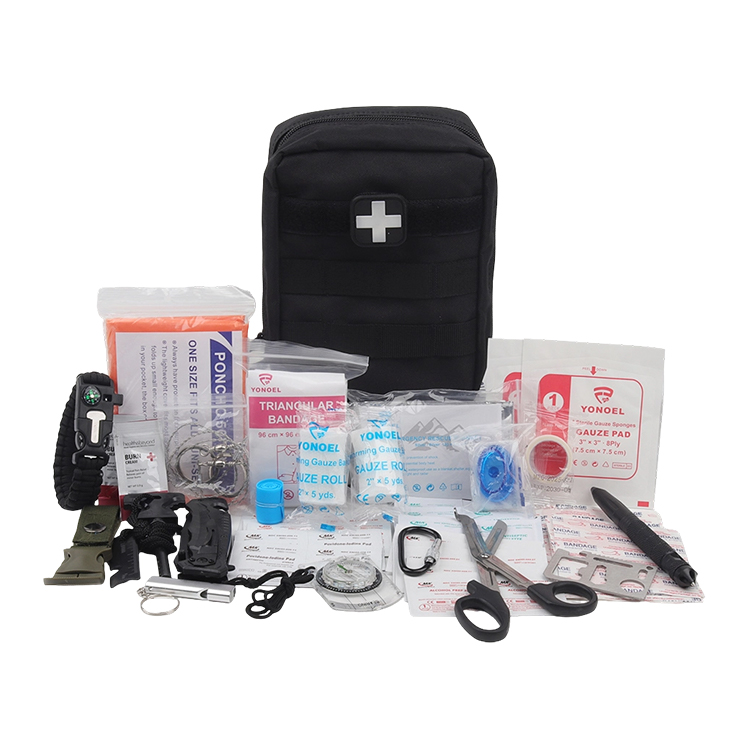
Maintenance of emergency kits is not usually a complex task, but it requires consistency. In many workplaces, it becomes something that is only noticed when a missing item is actually needed.
A First Aid Kit Supplier may provide refill structures that reduce variation between different storage locations. This helps ensure that kits placed in separate areas still feel familiar when opened.
In daily practice, maintenance is often closer to a small routine than a formal inspection system. It happens in short checks rather than detailed reviews.
Typical actions include:
| Maintenance area | What is usually observed | Typical response |
|---|---|---|
| Wound materials | Missing or used items | Refill selected items |
| Cleaning supplies | Seal condition | Replace if opened |
| Support items | Physical condition | Replace when worn |
| Outer packaging | Wear or deformation | Repair or replace |
In many environments, these checks are linked loosely to general safety routines rather than being treated as a separate system.
The supply chain behind emergency kits is usually layered rather than linear. Multiple material channels are usually involved, with each one handling different types of components in the supply process.
Before assembly begins, incoming materials are often checked for basic consistency. This includes condition, packaging integrity, and whether items match expected specifications. The focus is not only on individual quality but also on how well components will work together once assembled.
Quality control tends to appear at several points instead of a single checkpoint. This makes the process more stable when production volume changes or when kits are adapted for different environments.
| Stage of process | What is checked | Practical focus |
|---|---|---|
| Incoming materials | Basic condition and uniformity | Prevent early inconsistency |
| Assembly stage | Placement and grouping | Ensure functional arrangement |
| Final inspection | Overall completeness | Confirm kit readiness |
This layered approach helps reduce unevenness between kits, especially when production is continuous or distributed across different configurations.
No. 52, Hulian West Street, Jiangbei Street, Dongyang City, Jinhua City, Zhejiang Province, China
Quick Links
Product Center
Contact Us
 PRIVACY

 English
 Deutsch
 Français
 русский
 Español