A wall-fixed emergency kit is often treated as a simple object, but its role is wider than storage. In busy spaces, the main advantage is not only that supplies are available, but that they are easier to notice, easier to reach, and easier to return after use. A Mounted First Aid Kit fits into that logic because it stays in one predictable place and reduces hesitation when time feels tight.
In workplaces, shops, storage areas, and transport settings, people usually do not have time to search through drawers or lockers. A fixed location helps create a habit of response. People begin to remember where help items are placed, and that memory matters when attention is split. The placement itself becomes part of the safety routine.
A second point is organization. When items are stored in a visible and stable position, it is easier to keep the contents in order. That does not remove the need for checks, but it does make checks simpler. A well-placed unit also sends a quiet message that readiness is part of daily operations, not something used only after a problem appears.
| Area of focus | Practical effect | Why it matters |
|---|---|---|
| Placement | Easier to notice | Reduces searching time |
| Structure | Clearer access | Helps during stress |
| Storage method | More stable position | Supports routine checks |
| Visibility | Faster recognition | Useful in shared spaces |
A mounted unit is a first aid set that stays attached to a wall, cabinet, panel, or vehicle surface. That fixed position changes how people behave around it. Instead of wondering where it might be stored, they see one defined location and can move toward it with less delay.
The difference is small in calm conditions and more noticeable under pressure. In a shared workspace, several people may know the general area where help items are kept, but not all of them remember the exact drawer or shelf. A fixed setup reduces that uncertainty. It also lowers the chance that the kit gets moved without being returned to the same spot.
Another practical effect is routine. When supplies have a home, checks become easier to repeat. Missing items stand out more clearly, and the kit is less likely to be treated as random storage.
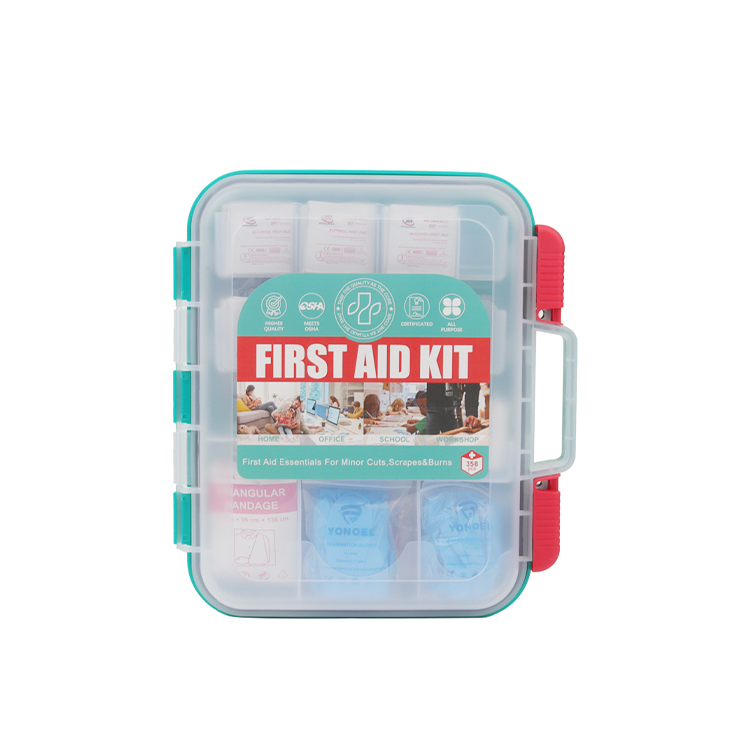
Placement should follow movement patterns, not convenience for one person. In a workspace, the kit should sit where people naturally pass, pause, or gather. It should not be hidden behind equipment, stacked boxes, or a closed door that is often blocked.
The same idea applies in smaller or mobile settings. In a vehicle, it should stay within reach and not shift around during travel. In a workshop, it should be visible from the main working area. In a shared building, the location should be easy to remember and easy to explain to new staff.
A simple rule is this: place it where someone in a hurry would expect to find it after one quick look. That is usually more effective than placing it where it looks tidy but is hard to reach.
When people are under stress, they do not search in a neat, logical way. They scan, guess, and move quickly. For that reason, visual clarity matters. Clear color contrast, simple labeling, and a consistent shape help the eye find the kit faster.
The internal layout matters just as much. If contents are placed in a loose pile, the user may spend time lifting items before finding the right one. If groups are arranged in a more familiar order, the hand can move more naturally. This is one reason a Mounted First Aid Kit can be easier to use than a loose bag kept in a shared drawer.
Useful design habits include:
These details do not make the unit complicated. They make it readable.
Stress changes fine motor control, attention, and memory. People may fumble with closures, miss small labels, or forget where they saw something a moment earlier. That is why the user experience should stay simple.
A good design choice is one that reduces decision-making. A clear opening path is helpful. So is a layout that avoids too many layers or hidden pockets. People should be able to open the unit, identify the needed item, and close it again without extra searching.
A few features are often useful:
A Mounted First Aid Kit should not demand much explanation. The more direct the interaction, the easier it is to rely on in an urgent moment.
A fixed emergency set only works well when it stays complete and easy to trust. In daily operations, small issues tend to appear quietly. A packet may be opened and not replaced. A label may loosen. A closure may stop feeling smooth. None of these changes are dramatic on their own, but they affect how people respond when they need the kit in a hurry.
Regular checks help keep the unit in a predictable state. That matters because users usually do not inspect contents before opening them. They assume the setup is ready. When that assumption is correct, response feels simpler. When it is wrong, time is lost.
A practical maintenance habit usually includes a quick visual check, a reset of the internal layout, and a review of anything that has been used or moved. The goal is not to make the process complicated. The goal is to keep the kit in a condition that matches the expectation created by its fixed position.
Some useful habits include:
A Mounted First Aid Kit can only support response if it remains familiar, complete, and easy to open.
Stability becomes more important when a space is not still. In moving vehicles, active workshops, and places with frequent vibration, a loosely fixed unit can shift, rattle, or become awkward to reach. A secure mounting method helps preserve both access and confidence.
The key is balance. The unit should stay in place, but it should not feel trapped. People need to remove or open it without struggling with the mount itself. If the attachment feels too rigid or too awkward, the kit may be avoided until it is too late.
Different spaces call for different attachment styles. A smooth wall, a metal panel, and a vehicle surface do not behave the same way, so the fixing method should match the surface and the level of movement around it. The goal is a setup that remains steady without making access slow.
In practical terms, a stable mount should do three things:
A Mounted First Aid Kit in a dynamic setting should feel secure when untouched and simple when needed. That combination reduces hesitation.
Different workplaces place different kinds of pressure on emergency storage. A quiet office, a workshop, a warehouse, and a transport setting do not face the same daily conditions. That means the internal arrangement, casing style, and installation approach may need to change from one setting to another.
In a calm environment, readability and convenience may matter most. In a busier setting, durability and fast recognition may matter more. In a shared space, the layout may need to stay simple enough for new users. In a mobile setting, the emphasis may shift toward secure placement and resistance to movement.
| Work setting | Main need | Design focus | Placement concern |
|---|---|---|---|
| Office area | Easy recognition | Simple layout | Visible wall position |
| Workshop | Frequent access | Durable casing | Clear path to reach |
| Warehouse | Fast locating | Strong labeling | Not hidden by storage |
| Vehicle | Stable hold | Secure closure | Within reach during motion |
The point is not to make one version serve every setting in the same way. It is to match the setup to the way people actually move, work, and react in that environment.
A Mounted First Aid Kit becomes more practical when its structure reflects real use rather than a generic layout.

No. 52, Hulian West Street, Jiangbei Street, Dongyang City, Jinhua City, Zhejiang Province, China
Quick Links
Product Center
Contact Us
 PRIVACY

 English
 Deutsch
 Français
 русский
 Español