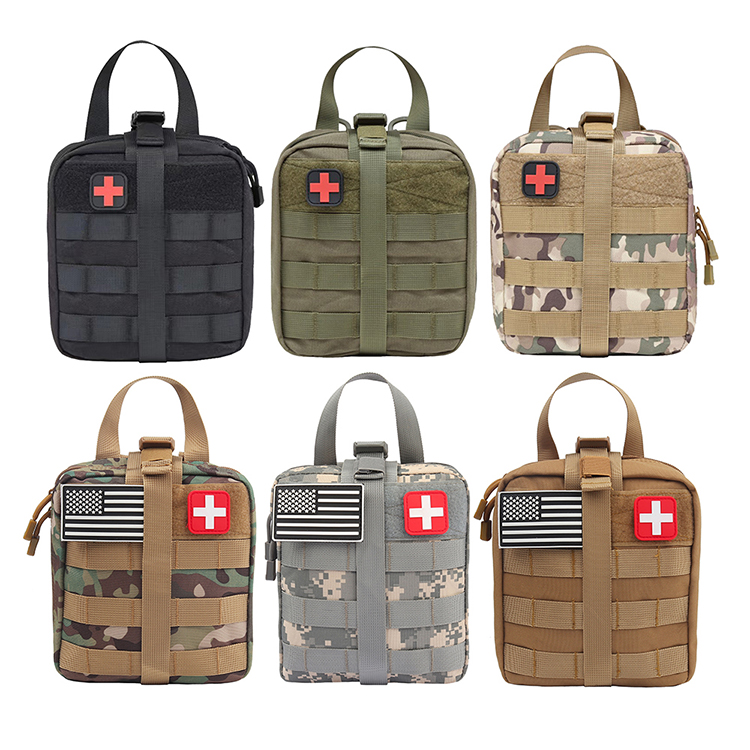
In real situations, a Combat Military First Aid Kit is usually treated less like a medical set and more like a fixed response tool that sits close to the body or gear. When something happens suddenly, there is rarely time to think through details step by step, so the structure of the kit matters more than anything else.
What tends to matter first is not the full content, but whether the right item can be reached without hesitation. In low visibility or fast movement conditions, even simple actions can feel slower than expected. That is why placement and familiarity often decide how smoothly the kit is used.
The general flow in use is not rigid, but it often follows a practical order:
In some cases, the sequence is not completed neatly. People may switch steps or return to earlier actions depending on what is happening at the moment.
A Combat Military First Aid Kit is built around this kind of uncertainty rather than ideal conditions.
Inside the kit, items are usually arranged around a simple idea: handle the most time-sensitive problems first. The contents are not there to provide full treatment, but to stabilize the situation long enough for the next stage of care.
When opened, the layout often looks straightforward, but under stress it can still feel less intuitive than expected. This is why each item tends to have a very direct function rather than overlapping roles.
| Component Type | Practical Role | How It Is Typically Used |
|---|---|---|
| Bleeding control tool | Helps reduce fast blood loss | Placed directly on injury area with firm pressure |
| Pressure wrap | Keeps dressing stable | Used after initial control to hold position |
| Protective seal material | Supports chest coverage | Applied over open chest area if needed |
| Cutting tool | Helps access wound area | Used to remove clothing or barriers |
| Cleaning material | Reduces surface contamination | Applied before covering or dressing |
In practice, not every item is used in every situation. Some remain untouched depending on the type of injury and how fast the response is.
A Combat Military First Aid Kit is closer to a selective set of tools than a complete medical system.
The internal structure usually reflects one priority: reduce searching. Instead of placing items randomly, they are grouped so that similar tools sit near each other.
In real use, people often rely on memory more than sight. This is important because conditions are rarely stable or well lit. When hands are occupied or movement is limited, the layout needs to support quick recognition without careful inspection.
There is also a practical reason for separation. Items used in early response are often placed closer to the outer layer, while secondary materials sit deeper inside. This avoids unnecessary unpacking during urgent moments.
Some common structural ideas include:
Over time, repeated handling makes the layout easier to remember, even under pressure. But without familiarity, the same structure can still take longer to navigate.
Under stress, fine movements and careful decision making become less reliable. Because of that, design choices tend to focus on reducing steps rather than increasing complexity.
One important factor is whether the kit can be opened and used without requiring precise hand control. In some situations, even small alignment tasks can slow down the process more than expected.
Another aspect is how quickly the user can distinguish between items. When everything looks similar, hesitation increases. When grouping is clear, selection becomes more direct.
There are also structural choices that support movement:
Not all features work the same way in every situation. In some cases, the environment itself affects how usable the design feels. What works in calm conditions may feel less predictable when movement is unstable.
A Combat Military First Aid Kit is therefore designed around reducing friction during action rather than aiming for ideal handling conditions.
In practical use, bleeding control is often treated as one of the most time sensitive actions. A tourniquet exists for situations where direct pressure alone is not enough or not fast enough to stabilize the condition.
What makes it important is not complexity, but speed of application and clarity of purpose. It is usually designed to be applied in a direct way, without requiring multiple adjustments. In real conditions, that simplicity matters more than anything else.
There are also situations where the placement is not ideal or the environment is unstable. In those moments, a tool that can still function with limited precision becomes more relevant.
A Combat Military First Aid Kit often includes it because it supports immediate action when other steps may take too long to organize.
Not all wound materials behave in the same way once applied. Standard gauze mainly works by covering and absorbing, while hemostatic gauze is used in situations where clot formation needs to be supported more directly.
In real use, the difference is less about appearance and more about how the material interacts with pressure and wound depth. Application often involves packing the material into the wound area rather than simply placing it on top.
This step can feel less intuitive during first use, especially under stress. The material is not passive, and its effectiveness depends on how it is positioned and held in place.
| Type of Material | Main Function | Typical Use Pattern |
|---|---|---|
| Standard gauze | Covers and absorbs fluid | Placed over wound surface |
| Hemostatic gauze | Supports clotting response | Packed into wound with pressure |
In a Combat Military First Aid Kit, both types may appear, but they serve different roles depending on the situation rather than replacing each other.
External conditions can influence how materials behave over time and during use. Temperature changes, moisture, and exposure to dust or friction can all affect packaging and handling.
In dry environments, materials may remain stable but packaging can become more rigid. In humid conditions, sealing becomes more important because moisture can affect usability of certain components. Cold conditions may influence flexibility of materials, making handling less smooth than expected.
These effects are not always immediate, but they can become noticeable when the kit is stored for long periods or used in inconsistent conditions.
A Combat Military First Aid Kit is often designed with protective layers to reduce direct exposure, but no structure fully removes environmental influence.
Different configurations are usually built around different usage expectations. Instead of a universal setup, most kits are arranged based on how they might be used in practice.
One important consideration is the balance between simplicity and coverage. A more compact setup is easier to carry and access, while a more expanded setup may include additional response options.
Another factor is how the items are arranged internally. Even with similar contents, layout differences can change how quickly items are located and used.
Before choosing a configuration, it is often useful to consider:
A Combat Military First Aid Kit is not only defined by its contents but also by how those contents are organized for real use conditions.
Even with a consistent structure, actual use may not always follow the same pattern, as conditions in the field often introduce variations that are difficult to fully standardize.
No. 52, Hulian West Street, Jiangbei Street, Dongyang City, Jinhua City, Zhejiang Province, China
Quick Links
Product Center
Contact Us
 PRIVACY

 English
 Deutsch
 Français
 русский
 Español