A combat first aid kit plays an essential role in tactical activities, especially in environments that require quick reactions and clear organization. The method of attaching this kit to tactical gear affects accessibility, comfort, and the user's overall mobility. A kit that is firmly attached helps maintain stability during movement and ensures the user can reach medical items without hesitation. This article explains the considerations, attachment approaches, and practical steps involved in securing a combat first aid kit to different types of tactical equipment.
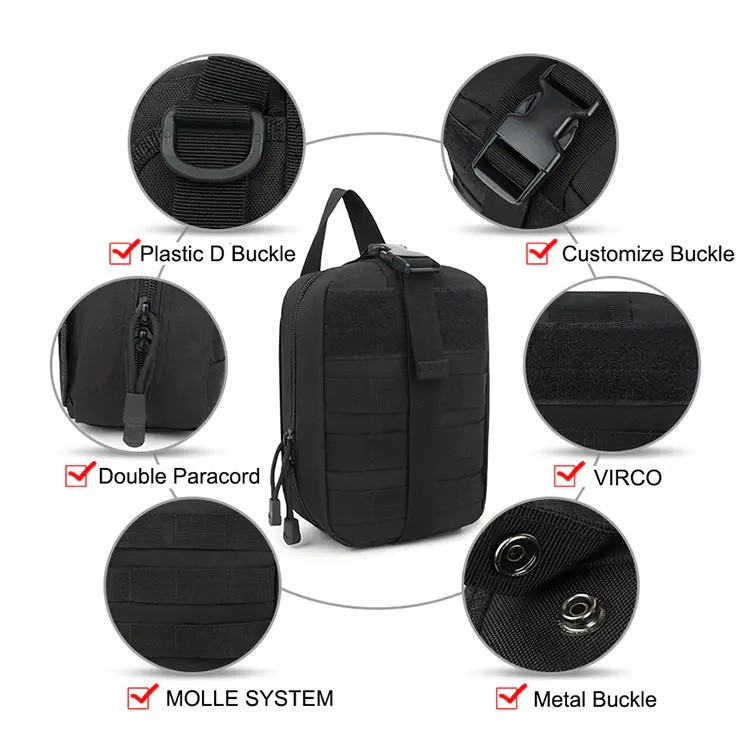
Tactical gear serves as the foundation for mounting a medical kit. The most commonly used platforms include plate carriers, battle belts, chest rigs, and backpacks. Each platform supports the kit differently due to variations in structure and available mounting areas. Plate carriers typically offer wide panels of modular webbing that allow the kit to sit securely on the front or side. Battle belts place weight around the hips, which can free the upper body for movement. Chest rigs concentrate storage on the front panel while keeping the sides open, and backpacks offer larger attachment zones for users carrying more extensive equipment.
The user's physical habits and operational environment often influence the best placement option. Some prefer a kit near the torso for immediate reach, while others mount it on the belt to keep the chest clear. Considering comfort, range of motion, and whether the kit is intended mainly for self-aid or assisting others helps guide an appropriate decision.
Combat first aid kits come in several structural forms, and each type interacts differently with tactical gear. A standard fixed pouch remains permanently secured once the mounting straps are woven into the gear. This approach suits users who desire consistency in placement. Tear-away kits attach to a base platform that stays fixed on the gear while the pouch can be quickly detached when needed; this brings speed and convenience when treating injuries. Hard-shell kits provide sturdy outer protection and often rely on brackets or reinforced loops.
Recognizing how these designs behave under physical stress is important. A tear-away kit should remain firmly anchored until intentionally removed. A hard-shell kit should resist impact without shifting. A fixed pouch should blend into the gear layout without creating movement imbalance.
The MOLLE system is widely used for attaching pouches and equipment. Rows of webbing stitched on tactical gear allow straps from a pouch to weave through them, forming a tight connection. The strength of this system lies in the friction and interlocking created when straps pass alternately through the gear and the pouch. This prevents the kit from swinging, sagging, or detaching.
When preparing to attach a kit, the user should first examine the webbing to ensure the rows align with the pouch straps. Clean stitching and even spacing help ensure reliability. A firmly woven strap creates a stable mount that can handle the challenges of running, crawling, climbing, and sudden changes of direction.
Where the kit is mounted affects both accessibility and mobility. The front of a plate carrier allows convenient reach from either hand but must be balanced with other essential tools. Side placement provides access without occupying central chest space. Mounting on the rear portion of a battle belt can keep the torso streamlined, while positioning on the side of the belt allows the user to access the kit with minimal twisting.
Environmental demands also shape placement. In tight spaces or vehicle operations, items on the front may snag or interfere with steering. During long periods of foot movement, a kit placed too low may collide with the legs. Comfortable reach, unobstructed motion, and reliable stability are the guiding principles.
A plate carrier provides one of the most stable mounting platforms for a combat medical kit. The process generally involves aligning the pouch straps with the carrier's webbing, weaving the straps through alternating rows, and locking the ends in place. Once secured, the kit should feel firmly attached without gaps or looseness.
Testing the attachment is important. Light side-to-side movement confirms whether the weaving is tight. Bending and twisting help confirm that the kit stays in place. A plate carrier often carries additional equipment, so the placement should not block magazines, radios, or identification patches.
Battle belts are favored by many users because they distribute weight around the hips rather than the torso. Mounting a kit on this platform provides clear access without crowding the chest. The kit is usually placed slightly behind the hip or offset toward the rear, where it remains reachable but unobtrusive.
Some belts use MOLLE webbing, while others accept direct-thread belt loops. The selected position should avoid interference with holsters, communication devices, or pouches used frequently during activity. Once secured, the user can perform bending, kneeling, and quick-turn movements to check for shifting.
Chest rigs offer lightweight configurations that keep essential items at hand. A medical kit mounted on the front of a chest rig is accessible, but users must balance the available space, as these rigs often carry ammunition and communication tools. The kit should not obstruct breathing or restrict upper-body movement.
A lightweight fixed pouch or compact tear-away kit is usually preferred for this platform. Ensuring that the pouch does not press excessively against the body when prone or seated helps maintain comfort across varied positions.
Tear-away kits require a mounting panel that stays attached to the gear. The pouch is then pressed onto the panel using hook-and-loop material. The mounting surface should be completely smooth to ensure firm adhesion. When attached correctly, the pouch remains stable until the user intentionally pulls it off.
Periodic checks ensure that dirt, loose threads, or weakened hook-and-loop surfaces do not reduce grip. The removal direction should feel natural and require only a controlled pull.
A hard-shell medical kit attaches through clips or reinforced loops designed to handle weight and impact. When attaching this type of kit, the mounting area should support the rigid structure without bending or lifting. The user should perform walking and light running tests to ensure the shell does not rub against other equipment or shift during movement.
Hard-shell designs often suit users who operate in rugged conditions where the kit may encounter debris or compression. Ensuring that the mounting bracket is fully engaged prevents accidental detachment.
Some users employ temporary solutions such as utility clips, elastic cords, or magnetic mounts. These methods work in controlled settings or for secondary kits but may not provide the same security as MOLLE. When using alternatives, the user must confirm that the kit remains steady through common movements. Temporary systems are best suited for lightweight medical items rather than full trauma pouches.
A well-placed combat first aid kit must be accessible with minimal effort while remaining safe from accidental detachment or damage. The user should be able to reach the kit with either hand whenever possible. At the same time, exposed placements should be avoided to prevent snagging on obstacles. Stability and ease of access work together to support fast response during demanding situations.
Regular testing ensures that the kit remains reliable. Simple activities such as short runs, crouching transitions, and crawling reveal whether the attachment holds under stress. Maintenance includes checking strap integrity, confirming that hook-and-loop elements retain their grip, and ensuring that webbing remains free of dirt or wear. These inspections help prevent issues at critical moments.
| Gear Platform | Suitable Kit Type | Notes |
|---|---|---|
| Plate Carrier | Fixed or Tear-Away | Good balance for reach and stability |
| Battle Belt | Fixed or Hard-Shell | Keeps chest clear of bulk |
| Chest Rig | Lightweight Pouch | Works well for compact setups |
| Backpack | Hard-Shell or Tear-Away | Good for support roles |
As a producer of tactical first aid kits and related gear, Yonoel offers manufacturing capabilities focused on steady performance, organized internal layouts, and dependable material quality. The factory's approach emphasizes practical construction that supports fast access and structured medical storage, suitable for a wide range of tactical, emergency, or outdoor uses.
Yonoel also supports customized development for buyers who require unique medical kit configurations or tactical pouch designs. With attention to consistent production standards and client needs, the factory works to provide reliable cooperation for businesses seeking long-term supply of combat first aid kits and related solutions.
No. 52, Hulian West Street, Jiangbei Street, Dongyang City, Jinhua City, Zhejiang Province, China
Quick Links
Product Center
Contact Us
 PRIVACY

 English
 Deutsch
 Français
 русский
 Español